BY: Shadrack Wafula – Communication Officer, CSO Network
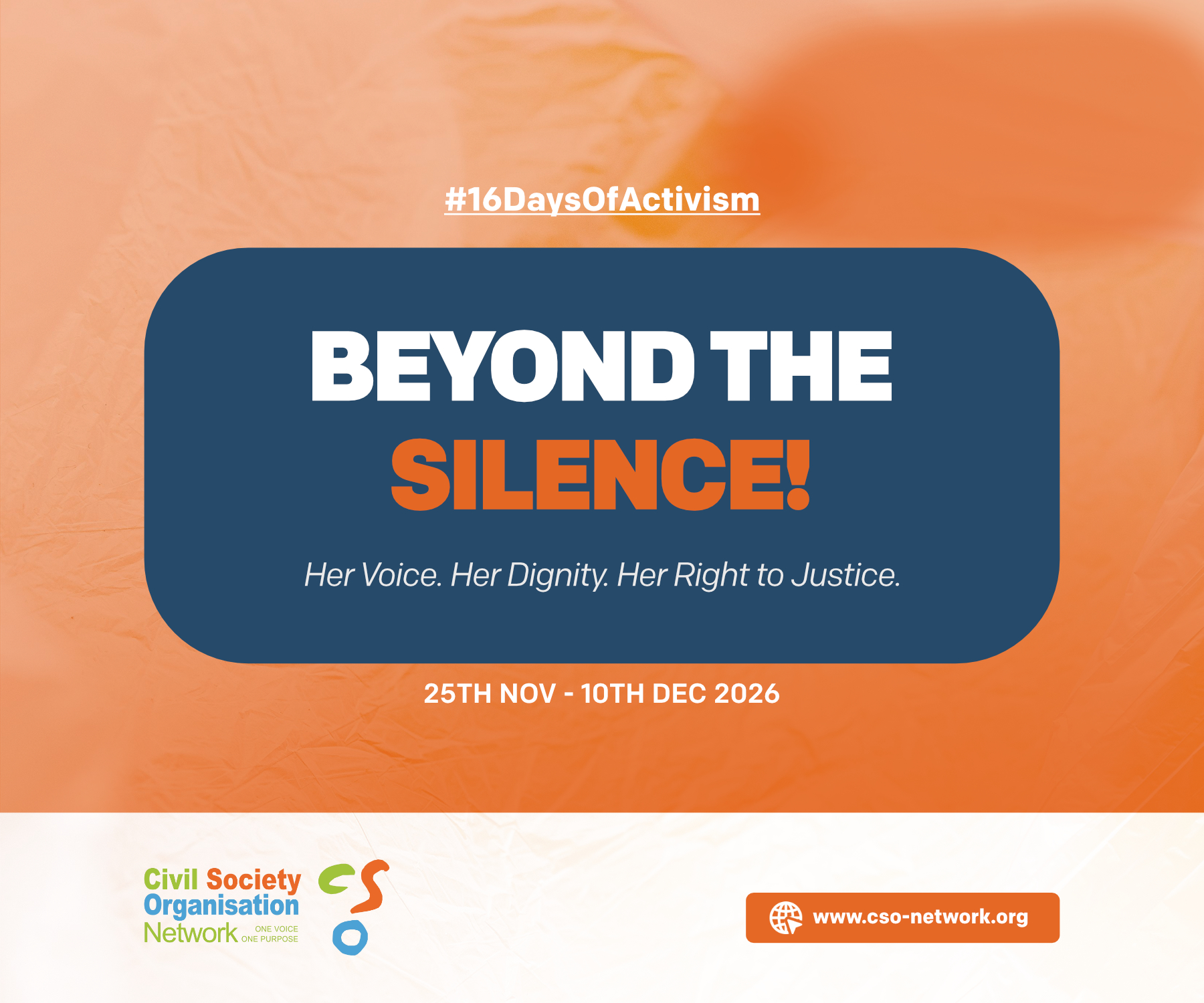
BEYOND THE SILENCE: Her Voice. Her Dignity. Her Right to Justice.
Gender-based violence is not simply an issue of individual suffering. It is a violation of human rights, a barrier to equality and a challenge to the safety, dignity and freedom of our communities. Yet, for many survivors, the violence itself is only the beginning of a much longer struggle — one marked by silence, stigma, disbelief, inadequate protection and the pursuit of justice that can often feel out of reach.
Some stories remain untold, not because they don’t matter, but because the cost of telling them can feel too great. For many survivors of gender-based violence (GBV), speaking out is not a straightforward decision. It may mean confronting fear, risking retaliation, facing judgment from family and community members, losing financial or social support, or reliving painful experiences in systems not always equipped to respond with sensitivity and care. Some fear that they will not be believed. Others worry that their experiences will become public knowledge, exposing them to shame, discrimination or further harm. There are those who have sought help before, only to encounter indifference, blame or institutions that failed to act.
And so, silence persists. But what if we have been asking the wrong question?
For too long, conversations about gender-based violence have often centred on why survivors do not speak out. Perhaps it is time to ask a different question: What happens when they do? Are they heard? Are they believed? Are they protected? Can they access the support they need? Does reporting lead to meaningful action and justice? These questions matter because speaking out should never be another battle a survivor has to fight alone.
The violence we see, and the violence we overlook: Gender-based violence takes many forms. It can be physical, sexual, psychological, emotional, economic or facilitated through technology. It can happen in homes, workplaces, schools, public spaces and online environments. It affects women and girls disproportionately, while also affecting people across different ages and backgrounds. Not every act of violence leaves a visible wound. Some forms of abuse take the shape of constant intimidation, threats, humiliation, controlling behaviour, financial deprivation, unwanted sexual conduct, online harassment or the misuse of digital platforms to threaten and exploit others. The absence of physical injury does not make the harm any less real.
Equally troubling are the attitudes and social norms that allow violence to continue. Victim-blaming, harmful gender stereotypes, unequal power relations and the normalisation of abuse can create environments in which perpetrators are excused while survivors are questioned. When a survivor is asked what they were wearing, why they stayed, why they did not report earlier, or what they might have done to provoke the violence, attention shifts away from the person responsible for the abuse. This is how silence is reinforced. Not only through threats and fear, but also through the reactions of the people and institutions from whom survivors should expect support.
Speaking out must lead to more than being heard: Courage should not be measured by how much suffering a survivor can endure before speaking. Neither should the responsibility for ending violence be placed on survivors alone. A survivor who reports abuse deserves more than a listening ear. They deserve a response that respects their dignity, protects their safety, safeguards their privacy and recognises their right to make informed choices. They should not have to navigate complicated systems without guidance, repeatedly recount painful experiences unnecessarily, or struggle to access support because of their circumstances.
Families and communities have a responsibility to create safe environments where survivors can seek help without fear of judgement. Service providers must respond with sensitivity and professionalism. Law enforcement and justice institutions must take reports seriously and pursue accountability. Duty bearers must strengthen the systems, resources and protections necessary to prevent violence and respond effectively when it occurs.
Believing survivors does not mean abandoning fair and lawful processes. It means listening without prejudice, treating disclosures with dignity and ensuring that concerns are handled seriously, safely and appropriately. Most importantly, support must respect the survivor’s choices. No one should be forced into a course of action that compromises their safety or takes away their agency. The real measure of our commitment to ending GBV is not simply whether survivors find the courage to speak, but whether our communities and institutions are prepared to respond.
Why this conversation cannot wait: Gender-based violence does not happen in isolation. It is sustained by unequal power relations, discrimination, harmful social expectations and systems that sometimes fail to prevent abuse or hold perpetrators accountable. This makes GBV more than a private matter. It is a human rights concern, a governance issue and a development challenge. When women and girls live in fear of violence, their ability to participate fully in education, leadership, economic activities and public life is undermined. When survivors are denied dignity or justice, trust in institutions is weakened. When abuse is normalised or concealed, entire communities bear the consequences.
Ending GBV therefore requires more than awareness messages. It requires honest conversations that challenge harmful attitudes, question the structures that enable violence and demand meaningful action from those responsible for protection and justice. It also requires men and boys to take an active role in challenging harmful norms, rejecting violence, respecting consent and promoting relationships founded on equality and respect. The conversation must reach homes, schools, workplaces, community spaces, digital platforms and institutions. It must move beyond condemnation of violence to examine the everyday behaviours, decisions and failures that allow it to persist. Above all, it must make clear that responsibility for violence rests with those who perpetrate it, and responsibility for building safer communities belongs to all of us.
Beyond the Silence: A conversation about voice, dignity and justice

Over the 16 days, we will explore four interconnected calls to action:
- HEAR HER: Every voice deserves to be heard. We must create spaces where survivors can speak without fear, intimidation, or prejudice.
- BELIEVE HER: Survivors deserve dignity, not judgement. Our responses must be guided by empathy, respect, and a rejection of victim-blaming.
- STAND WITH HER: Protection and support must be real. Survivors need safe, accessible and responsive support systems that respect their choices and confidentiality.
- DEMAND JUSTICE: Justice must not remain a promise. Institutions must fulfil their responsibilities, address barriers to justice and ensure accountability for acts of violence.
As the world marks the 16 Days of Activism Against Gender-Based Violence, CSO Network is taking this conversation BEYOND THE SILENCE, under the theme:
Her Voice. Her Dignity. Her Right to Justice.
The campaign is rooted in a simple but important understanding: encouraging survivors to speak out is not enough if the conditions they encounter after speaking remain unsafe, hostile or unresponsive. We want to look beyond the moment a survivor finds their voice and examine what follows. What happens when she reports? Is she protected? What happens when she shares her experience? Is she believed? When she seeks support, can she access it without stigma or discrimination? When she pursues justice, do the systems meant to protect her deliver? Through this campaign, we will create space for conversations that confront the realities surrounding GBV, challenge victim-blaming and harmful social attitudes, promote survivor-centred responses and reinforce the responsibility of communities and institutions to act.
The campaign will also highlight the importance of protecting survivors’ privacy, recognising technology-facilitated violence, strengthening community support and ensuring that the fight against GBV is not left to women and girls alone. Our approach is deliberate. We do not want to simply ask survivors to tell their stories. We want to question the conditions that make those stories difficult to tell, the attitudes that make disclosure painful and the institutional gaps that can leave survivors without meaningful support. We recognise that every survivor’s experience is different. Not everyone is ready or able to speak publicly, and choosing not to disclose an experience does not diminish a person’s dignity or right to protection and justice. Survivor-centred advocacy must never create another expectation or burden for those already affected by violence.
The responsibility does not end with awareness: The 16 Days of Activism provide an important opportunity to reflect, speak and mobilise. But the work of ending gender-based violence cannot begin and end with an annual campaign. It must be reflected in how we respond when someone seeks help, how we challenge harmful conversations, how institutions handle reports, how communities protect those at risk and how consistently perpetrators are held accountable. It calls for sustained investment in prevention, survivor support, accessible justice systems and the organisations working at the grassroots to advance the rights and safety of women and girls.
Every individual has a role to play. Every institution has a responsibility to fulfil. Every community must examine what it tolerates, what it overlooks and what it is willing to challenge. A survivor’s voice should never be met with blame. Her dignity should never be conditional. Her right to justice should never depend on how loudly she can demand it. As we begin this conversation, we invite communities, institutions, men and boys, civil society actors and all people committed to equality and human rights to look beyond the silence. Listen differently. Respond with compassion. Challenge the attitudes that sustain violence. Demand institutions that act. And stand for a society in which every woman and girl can live, participate and thrive free from violence.
Because when a survivor speaks, the responsibility is not hers alone to make something happen. It is ours to listen, to protect, to support, and to ensure justice.
#BeyondTheSilence #EndGBV #ProtectSurvivors #EnsureJustice #EndImpunity #16DaysOfActivism
Related Content
-
Beyond Silence #16Days
BY: Shadrack Wafula – Communication Officer, CSO Network BEYOND THE SILENCE: Her Voice.…
-
Amplifying GBV Survivors’ Voices for Justice
During this year’s(2024) 16 Days of Activism against Gender-Based Violence, we have been…
-
Governor’s Roundtable on GBV
In a concerted effort to address the pressing issue of Gender-Based Violence (GBV),…
-
Uniting Against Femicide – A Call for Justice
In a powerful display of solidarity and shared determination, Kenyans and like-minded individuals…